Predictable Pipeline: How Owner-Led B2B Firms Make Next Quarter a Number, Not a Guess
Ask most owner-led firms how next quarter looks and you get a story, not a number. Here is what it actually takes to build a pipeline you can forecast.
 By Kevin Durkin, Co-Founder, Strategy & AI Quant-Tek.AI
 Ask most owner-led B2B firms how next quarter looks and you get a story rather than a number. Two deals that feel close. One that has gone quiet. A referral somebody mentioned at a trade show in June. The story is usually not wrong, but nobody in the business can explain how it was assembled, which means nobody can say what happens if one of those deals slips. A predictable pipeline is not a bigger pipeline. It is one where the number you say out loud can be traced back to something you did on purpose.
What a predictable pipeline actually is
Three conditions have to hold at the same time. New opportunities arrive from activity you control rather than from luck. They move through stages that mean the same thing to every person on your team. And they convert at rates you have measured over real deals instead of estimated in a meeting. Remove any one of those and the forecast turns back into a feeling. You can have excellent salespeople and still be unable to forecast, because good instincts do not survive being written down.
It is worth separating this from volume, because the two get confused constantly. A firm can be busy, profitable, and completely unable to say where the next six months come from. Volume tells you what already happened. Predictability tells you what is about to happen, and only the second one lets you hire, invest, or commit capacity before the revenue actually lands.
Why owner-led firms rarely have one
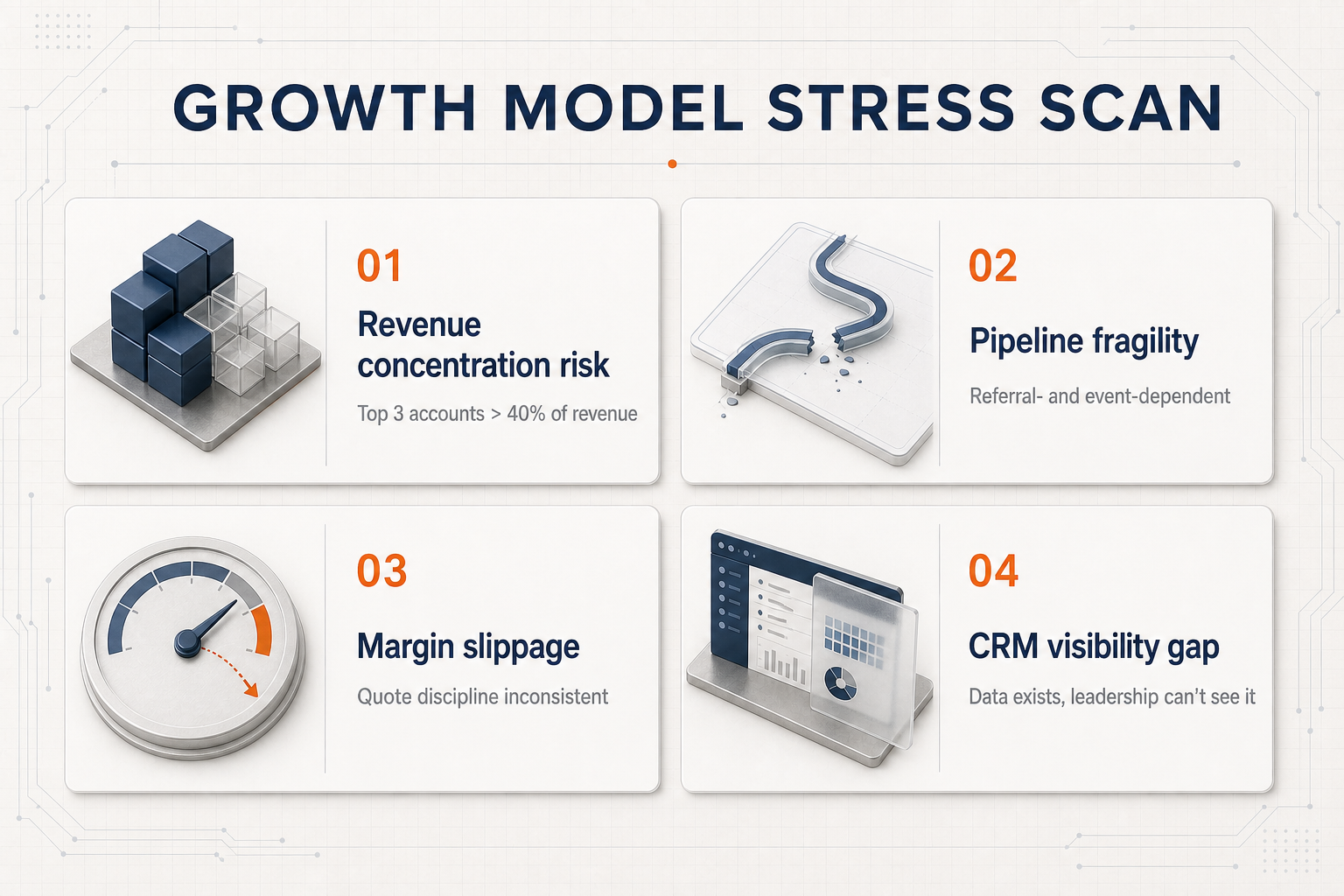
The cause is almost never effort. The pipeline was never designed, it accumulated. Each piece made sense when it was added, and together they produce a system nobody can read.
- Pipeline generation is passive. Referrals and repeat clients carry the load, which works beautifully until a quarter arrives where fewer of them show up and there is no lever to pull.
- Stages describe activity, not commitment. When a deal moves because you sent a proposal rather than because the buyer did something, the stage tells you what you did, not what they will do.
- The numbers live in one person's head. The founder can usually name every open deal from memory, which is genuinely impressive and also the reason nothing gets measured.
- Dead deals never leave. Opportunities that went quiet in April still sit in the pipeline in August, inflating the total and quietly destroying every ratio built on top of it.
The three inputs you have to be able to name
Forecasting is arithmetic once you have three honest inputs. Most firms are missing at least two, and the missing ones are usually the uncomfortable ones.
- Volume you create on purpose. How many qualified conversations does your firm start in a typical month through activity you decide to run? Referrals count as revenue, but they do not count as an input, because you cannot turn them up when you need to.
- Conversion between stages. What share of first conversations become qualified opportunities, and what share of those become clients? Measured across enough deals to be real, not across the three you remember best.
- Time in stage. How long a deal typically sits before it moves. Almost nobody tracks this, and it is what tells you whether a quiet deal is normal or already lost.
With those three, next quarter stops being a guess. You can work backwards from a revenue target to the number of conversations required, and see which input is actually limiting you. Most firms assume it is volume. More often it is conversion or time in stage, which is good news, because those are cheaper to fix.
How to build a predictable pipeline
This is a sequence, not a menu. Doing step four before step two is how firms end up with a tidy dashboard reporting numbers that mean nothing.
- 1
Define who a good deal is
Write down what a best-fit buyer looks like: size, situation, the problem they are already trying to solve. Everything downstream depends on this, because conversion rates measured across a mixed bag of good-fit and poor-fit deals tell you nothing you can plan around.
- 2
Give every stage an entry and exit rule
A deal enters a stage when a specific, observable thing has happened, and leaves when the next one has. Rules based on buyer behavior rather than your own activity are the only ones that hold up under pressure.
- 3
Clean out what is already there
Go through the current pipeline deal by deal and close what is genuinely gone. This is unpleasant and takes an afternoon. Every ratio you calculate afterwards will be wrong if you skip it.
- 4
Measure the three inputs for one full cycle
Track volume, stage conversion, and time in stage across a period long enough to cover your normal sales cycle. Do not adjust anything yet. You are establishing what is true today, not what you would like to be true.
- 5
Name one repeatable source of new conversations
Pick a single activity you can run every week regardless of how busy the team gets, and hold it for a quarter. One source you sustain beats four you abandon, and it turns a pipeline from something that happens to you into something you operate.
What changes once the number is real
The first thing owners notice is not more revenue. It is fewer surprises. A slow month stops being alarming because you can see it coming eight weeks out and you know which input caused it. Hiring decisions get easier, because you can tie a new person to a number instead of to a feeling that things are picking up. And the pipeline stops depending on the founder being personally involved in every deal, which is usually the constraint that mattered most all along.
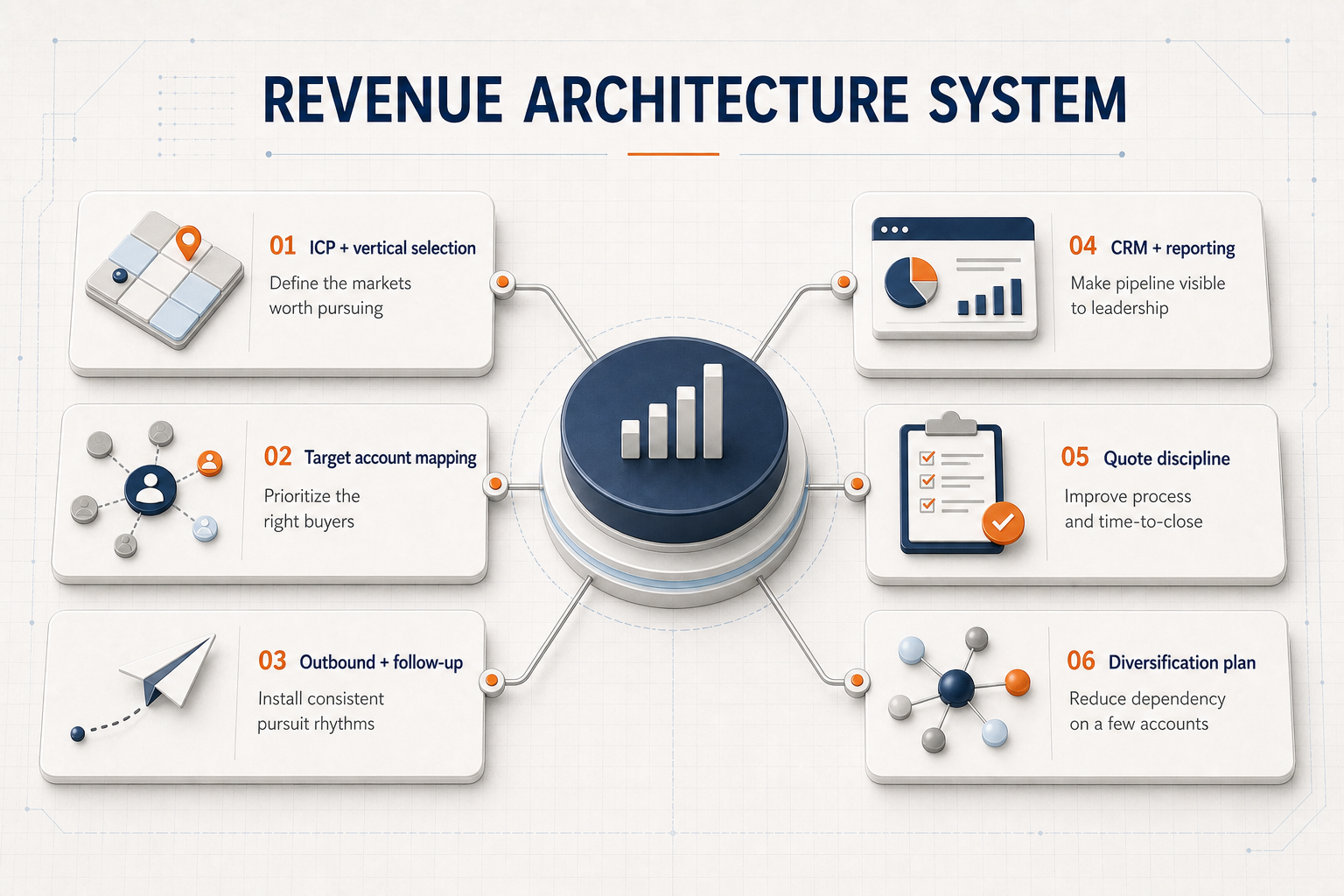
None of this works in isolation. The sales pipeline stages you define determine whether the data means anything, the sales pipeline metrics you track determine whether you can see a problem before it costs you a quarter, and the pattern holds across industries: the same structure is what lets owner-led manufacturers build a predictable sales pipeline without relying on referrals. That is why we install the whole system rather than fixing one stage at a time. A pipeline is only as forecastable as its weakest handoff.
Where to start this week
Open your pipeline and close every deal that is genuinely dead. Then count how many qualified conversations you started last month, and how many of them came from something you chose to do rather than something that arrived. Those two answers tell you most of what you need to know. If the second number is small, that is your starting point, and it is a better one than it feels like, because it is fixable on purpose. You can read more about how we work before you ever talk to us.