Sales Pipeline Stages: How to Define Stages Your Team Can Actually Manage
Most owner-led firms track deals in stages nobody can define the same way twice. Here is how to set sales pipeline stages with clear entry and exit rules, so the pipeline finally tells you the truth.
 By Kevin Durkin, Co-Founder, Strategy & AI Quant-Tek.AI
 Ask two people in an owner-led firm what "proposal sent" means and you will often get two different answers. One means the quote went out this morning. The other means the buyer has seen the numbers, agreed on scope, and is waiting on one signature. Same label, completely different deals. That is the quiet reason so many pipelines look healthy right up until the quarter closes short.
Sales pipeline stages are supposed to fix that. Done well, they turn a list of open deals into a picture you can act on. Done loosely, they turn into folders where deals go to sit.
What sales pipeline stages actually are
A stage is a description of where the buyer is in their decision, not a description of what your team did last. That distinction is the whole game. "Followed up twice" is your activity. "Buyer has confirmed budget and named a decision date" is their position. Only the second one tells you anything about whether the deal will close.
Every stage needs two written rules: what has to be true for a deal to enter it, and what has to be true for the deal to leave. Without those rules, the stage is a label, and labels are how forecasts drift.
Why vague stages quietly break the forecast
When stages are loose, three things happen in order. Deals get graded generously, because there is no rule to argue with. Stalled deals stay in late stages, because moving one backward feels like admitting defeat. And the total pipeline number climbs while actual revenue stays flat.
By the time the gap shows up, it is too late to fill it. This is also why sales pipeline metrics fail in firms that skipped this step. Conversion rate by stage means nothing if two people define the stage differently. The numbers are only as honest as the stage definitions underneath them.
Five sales pipeline stages that fit owner-led B2B firms
You do not need a complicated model. Five stages cover almost every owner-led firm we work with, and each one has a rule that ends the debate.
1. Identified
A real company that matches your best-fit profile, with a named contact. Enters when you can name the account and the person. Leaves when that person has responded to you at least once. Interest you have imagined does not count.
2. Qualified
The buyer has a problem you solve, and you know enough to say so. Enters on a real conversation. Leaves when you have confirmed the problem, roughly what it costs them, and who else has to agree. If you cannot answer those three, the deal is not qualified yet no matter how warm the call felt.

3. Scoped
You and the buyer agree on what the work looks like. Enters when scope discussion starts. Leaves when the buyer has confirmed the approach and there is a number they are expecting. Surprising someone with a price is a sign this stage got skipped.
4. Decision
The proposal is with the people who decide. Enters when it lands in front of them, not when you hit send. Leaves on a yes, a no, or a written date. "They are reviewing it" is not an exit condition, and treating it like one is how late-stage pipeline inflates.
5. Won or closed out
Signed, or honestly retired. Closing a deal out is not a loss of face. It is what keeps the remaining pipeline believable, and it moves the buyer into nurture instead of leaving them stuck in a stage nobody looks at.
- 1
Map the last twenty deals you closed
Write out what actually happened between first contact and signature, in the buyer's terms. Patterns show up fast, and the real stages are usually already there in the sequence.
- 2
Name each stage after the buyer's position
Use language that describes where the buyer is, not what your team did. If a stage name contains one of your own activities, rewrite it.
- 3
Write one exit rule per stage
Each rule must be checkable by anyone on the team without asking the salesperson how they feel about it. One sentence is enough, and shorter is better.
- 4
Set a maximum age for every stage
Decide how long a deal can sit before it gets a forced decision. When it passes that age, either name the next step and its date or move the deal back to nurture.
- 5
Run one review before you change anything else
Regrade every open deal against the new rules in a single sitting. The pipeline will shrink. That drop is the number you were previously forecasting against.
How to keep the stages honest
Definitions drift the moment nobody is checking them. A few habits keep them intact:
- Grade against the rule, not the relationship. The written exit condition settles it, every time.
- Let deals move backward. A deal that slips a stage is information. A deal that never slips is a fiction.
- Review weekly, redefine quarterly. Weekly catches stalls. Quarterly catches definitions that quietly loosened.
- Keep the stage count small. Four to six. If two stages need the same explanation, they are one stage.
- Attach one number to each stage. Count of deals and average age. That is enough to see where the leak is.
Stages are the skeleton a repeatable sales process hangs on. The process describes how you sell. The stages describe how you know where you are. Firms that write one without the other end up with a documented method nobody can measure, or a dashboard nobody trusts.
Where stages sit in the bigger system
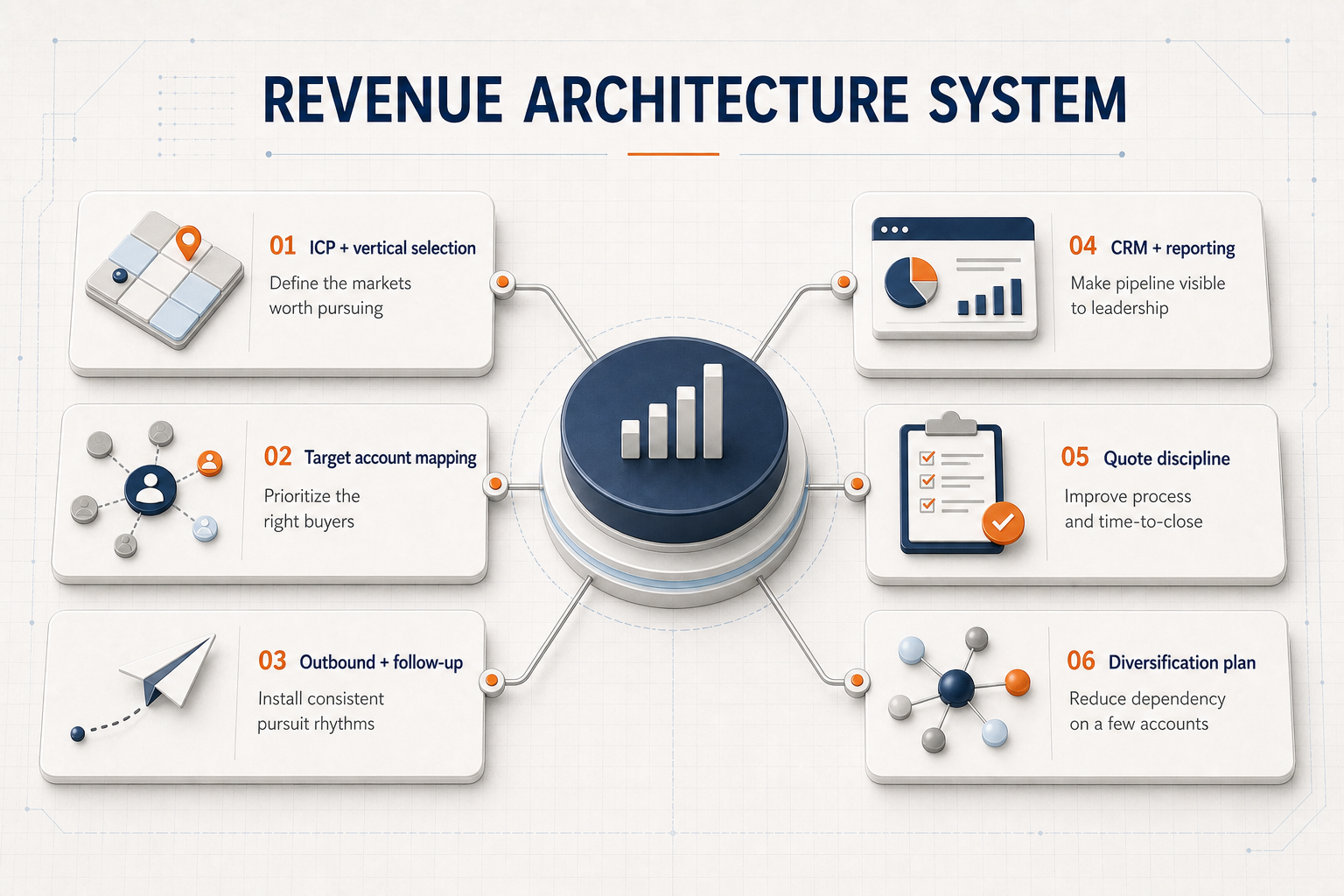
Clear stages make your existing pipeline legible. They do not create demand on their own. A firm that fixes its stages and still relies on referrals now has an accurate view of a pipeline that is too thin, which is progress, but only the first half of it. Building a predictable sales pipeline means pairing honest stages with a front end that puts good-fit buyers into stage one on purpose.
Where to start
Pick the five stage names this week. Write one exit rule under each. Then regrade every open deal in one sitting and accept the smaller number as the real one. Most owners find the exercise uncomfortable and clarifying in about equal measure, because it usually exposes one stage where deals have been piling up for months.
That one stage is where the next quarter is decided. Everything after it is easier once you can see it.