Ideal Customer Profile: How Owner-Led B2B Firms Decide Who They Are Actually For
Most owner-led firms can name their three best clients but not what those clients had in common. Here is how to turn that pattern into an ideal customer profile your team can actually use.
 By Kevin Durkin, Co-Founder, Strategy & AI Quant-Tek.AI
 Ask an owner-led firm who its best clients are and you will usually get three company names and a shrug. The names are right. What is missing is the part underneath them: what those three had in common before they ever became clients, and how you would recognize a fourth one in an inbox next Tuesday. That gap is what an ideal customer profile closes. It is not a marketing exercise and not a persona with a stock photo attached. It is a written description of the kind of company your business is measurably good for, built from deals you have already run.
What an ideal customer profile actually is
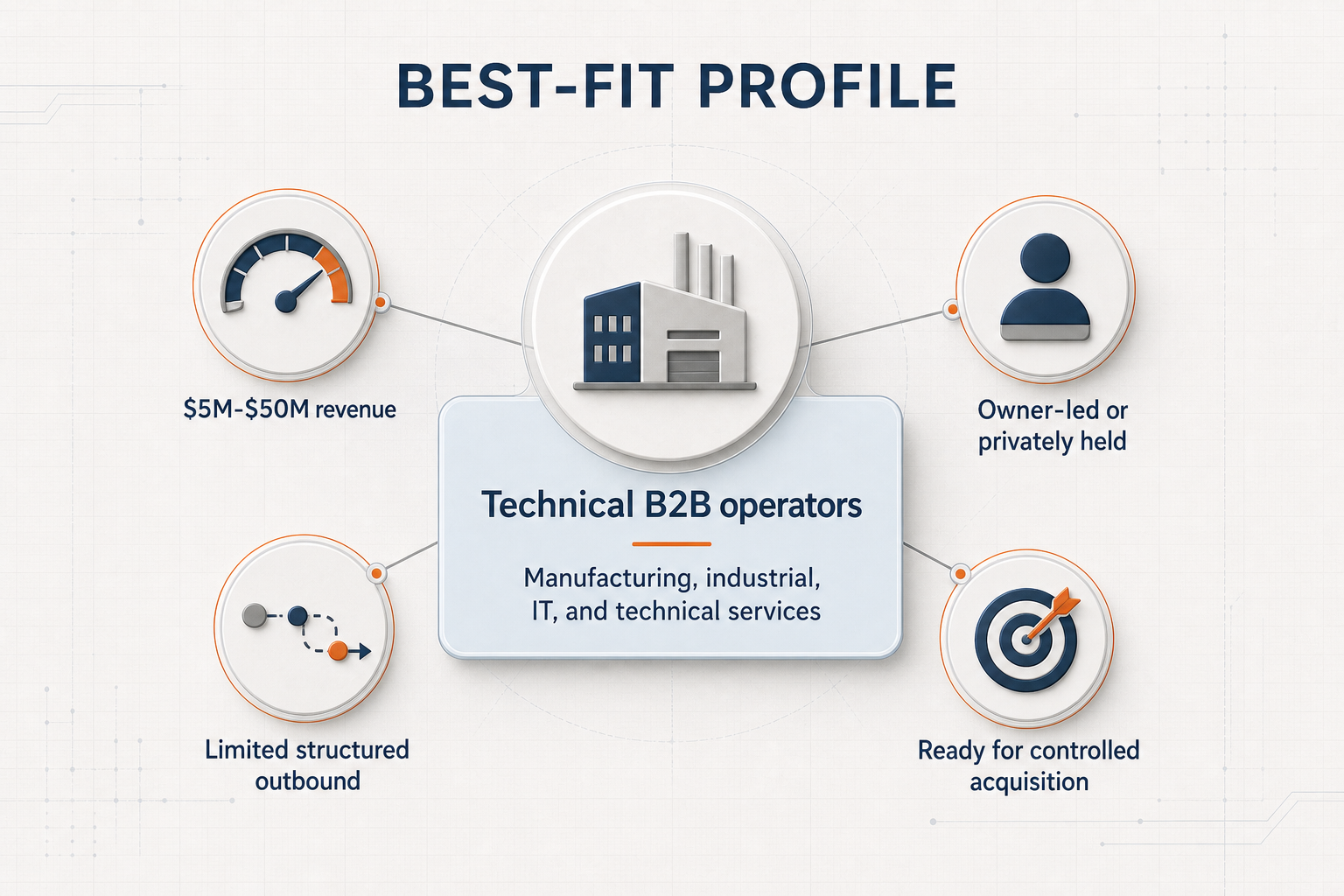
An ideal customer profile describes the company, not the person. It is the firmographic and situational picture of an account where your work lands well: the size, the industry, the way they buy, the problem they already know they have, and the conditions inside the business that make your help worth paying for. The individual you talk to matters, but that is a buyer persona and a separate document. You cannot prospect against a personality. You can prospect against a company with forty employees, two salespeople, no formal follow-up, and a founder still closing every deal personally.
The test is simple. Hand it to someone who has never worked at your firm, give them a list of a hundred companies, and see whether they sort it roughly the way you would. If they cannot, the profile describes your preferences rather than fit.
Why the generic version fails owner-led firms
Most firms have something on file. It was usually written once, during a planning session, and it has not been opened since. The reason it gathers dust is almost always one of four things.
- It was written from ambition rather than evidence. It describes the clients the firm wants next year, not the ones it has already served profitably, so nothing in it can be checked against a real outcome.
- It is too broad to exclude anything. Covering manufacturers and IT firms with 10 to 500 employees across the Midwest does not narrow a list. It restates that you sell to businesses.
- It lists attributes but never triggers. Size tells you whether you can help. What changed inside the business this quarter tells you whether they will buy now, and that half is usually missing.
- Nobody attached a decision to it. If no lead has ever been turned away because of it, the team correctly treats it as optional.
The evidence is already in your client list
You do not need research you have to buy. Separate the accounts you have already served into three groups: profitable and pleasant, profitable and painful, and neither. Then find what the first group shared at the moment they came in. Not what they became after you fixed things. What was true on day one.
For most owner-led B2B firms the pattern is narrower and stranger than expected, and it is rarely the industry. It is usually something like: they had already tried to solve this internally and failed, or one person owned the outcome, or revenue had grown past what the founder could hold personally. Those conditions are what make your work stick. Write them down and you have the working core of your ideal customer profile.
- Firmographics: size, revenue band, industry, geography, structure. The easy part, and the part that filters the most obvious mismatches.
- Operating conditions: how they sell today, who owns the pipeline, what breaks when the founder is unavailable.
- Trigger events: a hire, a lost quarter, a new line of business, a referral source drying up. These predict timing, which attributes never do.
- Disqualifiers: the traits that made a past engagement painful even when the revenue was fine. The most valuable list, and the one most firms refuse to write.
How to build yours in an afternoon
This does not require a research project. It requires a couple of hours, your last two years of closed deals, and a willingness to be unflattering about a few of them.
- 1
Pull every client from the last 24 months
List them all, including the ones that ended badly. Add what you earned and roughly how much of your team time each consumed. Revenue alone hides the accounts that quietly cost more than they paid.
- 2
Sort them into three buckets
Profitable and smooth, profitable and painful, and everything else. Do it fast. The first bucket is your evidence base, and it is usually smaller than you expect.
- 3
Find what the top bucket shared before day one
Look at what was happening inside each of those companies when the deal arrived. Ignore anything that only became true after you started working together. You want conditions observable from outside.
- 4
Write the disqualifiers from the painful bucket
For each account that was profitable but painful, name the thing you would now spot early. No single decision maker. Three approvals for any budget. These become your fastest filters.
- 5
Turn it into one page with a scoring rule
Attributes, conditions, triggers, disqualifiers, and a plain rule for what makes a lead worth a call. One page, or it will not get used. Then apply it to the leads sitting in your pipeline and see how many survive.
- 6
Review it after one quarter of real deals
Check every deal you won and lost against the profile and fix what it got wrong. One that never changes was never being used to make decisions.
What changes once you have one
The first effect is subtraction. Fewer proposals, fewer discovery calls with companies that were never going to buy, and a noticeable amount of the week handed back. The second is that everything downstream gets sharper. A defined profile is the input to how you qualify B2B leads once one arrives, it is what makes outbound worth running at all in lead generation for IT services companies and firms like them, and it is one reason a predictable pipeline is possible at all. You cannot forecast conversion rates across companies that have nothing in common.
It also changes what your marketing can say. Once you know which conditions you solve for, the language stops being about your capabilities and starts being about a situation the reader recognizes. That is the difference between copy that gets read and copy that gets skimmed. It is why we start every engagement here rather than with tactics.
Where to start this week
Pick your three best clients and write one sentence each about what was true of their business the week before they contacted you. If the sentences share nothing, look at three more. If they do, you have found the first line of your ideal customer profile, and the next lead that matches it should get a call before anything else in your inbox.