Lead Response Time: Why the First Hour Decides Which B2B Deals You Win
Most owner-led firms lose deals they never knew they had, in the hours between an inquiry and a reply. Here is how to measure lead response time and cut it for good.
 By Kevin Durkin, Co-Founder, Strategy & AI Quant-Tek.AI
 A buyer fills out your form on Tuesday afternoon. They are in the middle of a problem, they looked at three firms, and yours was one of them. On Thursday morning someone sees the notification and sends a friendly note asking when might be a good time to talk. No reply. Nothing about that inquiry was low quality. It went cold in the gap, and the only thing that changed in those forty hours was who answered first. Lead response time is the least glamorous number in your pipeline and one of the few you can improve this week without hiring anyone.
What lead response time actually measures
Lead response time is the elapsed clock between the moment a buyer raises their hand and the moment a real person from your firm makes contact. Not the moment the notification arrived. Not the moment somebody read it and made a mental note. Contact. That distinction matters because most owner-led firms feel fast and are not. The inquiry lands during a client call, gets remembered at 6pm, gets handled the next morning if nothing urgent happens first, and the version of events everyone believes is that you replied the same day.
Speed carries weight in B2B not because buyers are impatient, but because the moment someone submits a form is the one moment you know for certain they are thinking about the problem. Every hour after that, attention drains back into their actual job. You are not competing only against the other firms they contacted. You are competing against the meeting they walk into at two o'clock.
Why a slow reply costs more than it looks
A late response does not just lower the odds on one deal. It quietly distorts everything downstream of it, which is why firms often misdiagnose the problem as lead quality.
- You lose the buyers who were most ready. The people with real urgency are the ones who keep moving, and they move toward whoever answers first. Slow response filters your pipeline in exactly the wrong direction.
- You blame the source instead of the process. When the fastest-moving buyers disappear before anyone talks to them, the channel that produced them looks weak, and firms cut spend on something that was working.
- The conversations you do get are harder. By the time you reach a buyer who has already spoken to someone else, you are answering their questions second, against a frame another firm set.
- Your forecast gets noisy. Deals that never received a real first touch still sit in the pipeline as open opportunities, which makes every number built on top of them softer than it looks.
How to measure it honestly
Before you fix anything, get a real baseline. Take your last twenty to thirty inquiries and write down two timestamps for each: when it arrived, and when a person from your firm actually made contact. Then look at three things. The median tells you what normally happens. The worst five tell you what happens when the week gets busy, which is the number that costs you deals. And the share that never received any response at all, which in most firms is not zero, is usually the single most uncomfortable finding in the exercise.
Do this by hand the first time. A dashboard gives you an average, and the average hides the Friday afternoon inquiry that sat until Monday. You are looking for the pattern behind the delays: which day, which channel, and which person.
How to cut your lead response time
Speed is not a personality trait, and telling the team to be quicker does not survive a busy month. What works is removing the decisions that create hesitation, so responding becomes the default behavior rather than an act of discipline.
- 1
Set a standard you will actually hold
Pick one target and write it down: every inquiry gets a human response within one business hour, and nothing sits overnight. A standard nobody can recite is not a standard. One clear number beats a policy document.
- 2
Name one owner per channel
Every inquiry route needs a single person responsible for the first touch, with one named backup. Shared inboxes are where response time goes to die, because everyone assumes someone else has it.
- 3
Route the notification to where the owner already looks
If your alerts land somewhere nobody checks between client work, the clock starts and nobody hears it. Send it to the place that person genuinely sees during the day, and make it obvious when one is unanswered.
- 4
Write the first touch in advance
Draft three or four short openers for the situations you actually see, each ending with two specific times to talk. Blank-page hesitation is a real cause of delay, and a good opener you send in ten minutes beats a perfect one you send tomorrow.
- 5
Review the misses every week
Once a week, look only at the inquiries that missed the standard and ask what happened. The answer is almost always structural, not personal, and fixing the structure is what keeps the improvement from decaying after a month.
What to do when you genuinely cannot reply right away
Owner-led firms have real constraints. You are on site, in a client call, or it is nine at night. The goal is not to pretend otherwise. It is to make sure the buyer never sits in silence wondering whether their message went anywhere. A short acknowledgement that names who will follow up and gives a specific time holds attention through the gap. What loses deals is not a two-hour delay. It is two hours that feel like they might be two days.
The same applies to inquiries that are not a fit. A quick, honest answer costs ten minutes and earns you a reputation with people who talk to other buyers.
How response time fits the rest of your pipeline
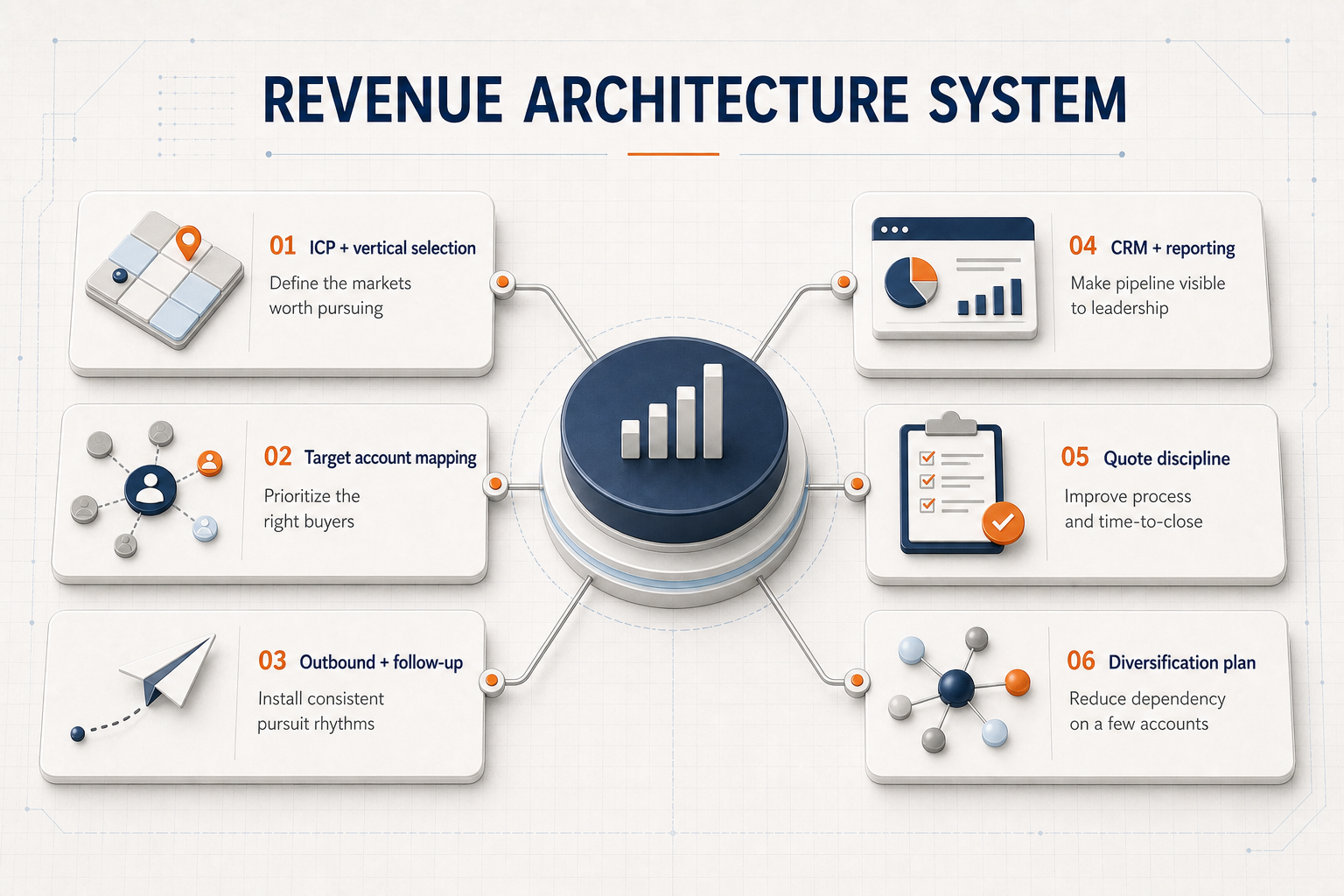
Fast replies to the wrong buyers just help you waste time faster, which is why response time only pays off when the stages around it are already defined. The criteria you use to qualify B2B leads decide which inquiries deserve an immediate call versus a short note, and everything you learn on that first touch feeds the sales follow-up system that carries the deal from interest to a booked conversation. Do that consistently and the effect shows up where it matters, in a predictable sales pipeline you can forecast instead of hope for. That is the point of how we install the system end to end: each stage is fast because it knows exactly what the one before it hands over.
Where to start
Pull your last twenty inquiries this week and write down the two timestamps. Look at the median, the worst five, and the ones nobody ever answered. Then pick one standard, name one owner, and hold it for thirty days. Most firms find their lead response time drops by more than half without a single new tool, because the delay was never a capacity problem. It was an ownership problem. You can read more about how we work before you ever talk to us.